Essay / 2025
Your AI Multiplier
AI is changing the relationship between what you can do personally and what you can accomplish. As AI systems become more capable, your effectiveness will increasingly depend on the capabilities you can direct.
That’s your AI multiplier: the increase in your effectiveness made possible by the AI tools and agents you use. It depends on the systems you choose, the work you assign them, and your ability to judge the results.
The AI Tipping Point
AI models can write, code, and solve a growing range of problems. Their progress is measurable on specific benchmarks, though performance on a test doesn’t necessarily translate into reliable performance in everyday work. The International AI Safety Report 2025 documents both these advances and their limitations.
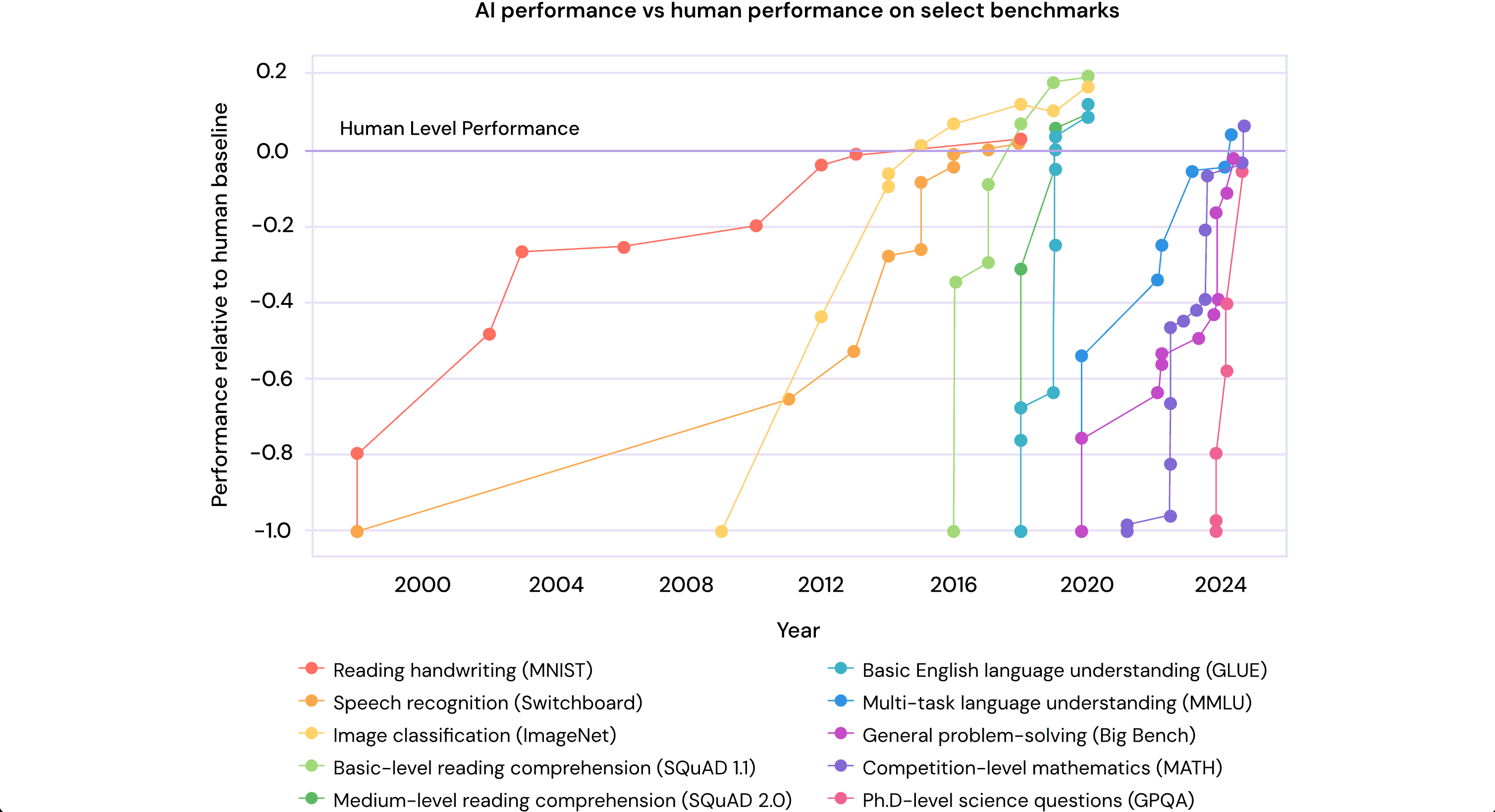
The practical opportunity is becoming clear. As AI can perform more useful work reliably, companies can use it to reduce costs and expand their capabilities. The question is how to turn those capabilities into better results.
Mature Industries Will Be Transformed
In established industries, I expect a widening divide between companies that effectively use AI and those that don’t. Firms that automate work where doing so improves cost, speed, or quality, while investing in the judgment and relationships that remain essential, will have an advantage.
AI will replace some tasks and may eliminate some roles. It will also change what people can accomplish together. Companies that combine people and AI effectively will be able to operate with less routine reporting, fewer manual handoffs, and faster access to information.
The value of automation depends on the whole process. A task completed instantly creates little advantage if checking and correcting it takes longer than doing it yourself.
Entirely New Industries Will Emerge
While AI reshapes mature industries, it will also create conditions for new ones to emerge. This is a pattern we’ve seen before. The internet gave rise to e-commerce, social media, and cloud computing. As a technology makes previously expensive or impractical activities accessible, new businesses become possible.
AI could follow a similar path. As the cost of certain kinds of cognitive work falls, products and services that once required large teams may become viable for small companies or individuals.
We can’t yet know which of these businesses will become major industries. But we can identify the underlying opportunity: more people will be able to attempt work that previously required resources beyond their reach.
People Will Be Empowered Beyond Their Individual Capabilities
AI gives individuals access to capabilities they haven’t personally developed. A single person can coordinate AI tools and agents that perform specific tasks faster, or bring specialized capabilities that the person lacks.
Consider a consultant preparing a market assessment. AI could help organize source material, compare findings, and draft an initial analysis. The consultant would still need to assess the evidence, resolve conflicting assumptions, and take responsibility for the recommendation. If the combined process produces sound work in less time, the consultant’s effectiveness has increased.
In tech, we’ve long talked about the “10x engineer”, someone considered far more effective than their peers. AI extends that idea to a much wider range of work. The potential increase isn’t unlimited, and it won’t be the same for everyone. It depends on which constraints AI removes and which still require human attention.
Two people using the same tools can get very different results. Knowing what to ask, providing the right context, and recognizing a flawed answer all affect the size of the multiplier.
Your Personal AI Multiplier Will Shape Your Success
Your AI multiplier is driven by the combination of tools and agents you orchestrate and the judgment you bring to their use. Expertise remains valuable because it helps you choose meaningful problems, direct the work, and evaluate what comes back.
The individuals who understand this and invest in learning how to use AI effectively can build a substantial advantage. That investment involves experimentation: identifying useful applications, testing the results, and incorporating what works into everyday practice.
Start with a recurring constraint in your work: something valuable you can’t do well, quickly, or at sufficient scale. Determine whether AI can reduce that constraint, accounting for the time it takes to direct and review the work.
Your success in the coming decade will increasingly depend on how well you combine your own capabilities with those you can direct. Building your AI multiplier means learning how to turn that combination into useful results.